
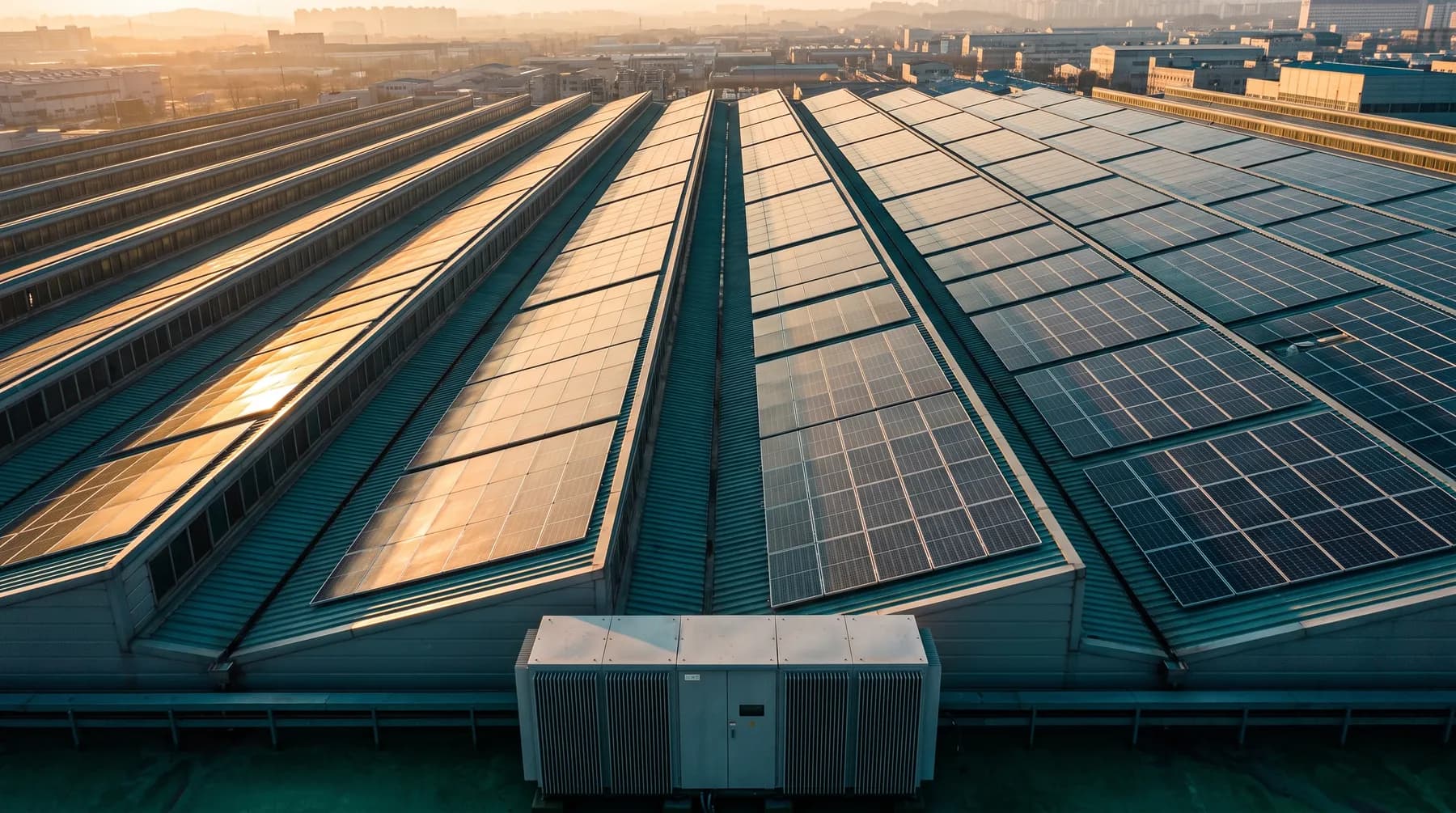
Aerial photograph of solar panels on a factory roof

Rooftop PV

Rooftop Solar
Factory and warehouse roofs: lease returns against owner-invested

A roof carries the lightest permitting burden of any site.
What matters instead is structural capacity, waterproofing, and whether leasing or investing yourself pays more.
We compare the 20-year cash flow of both.

Rooftop solar is a generating plant installed on the roof of a factory, warehouse, or commercial building. No new land has to be secured and setback rules do not apply, which makes the permitting burden comparatively light.

Rooftop solar is a generating plant installed on the roof of a factory, warehouse, or commercial building. No new land has to be secured and setback rules do not apply, which makes the permitting burden comparatively light.

Site photograph related to Rooftop Solar
The order of checks on a rooftop project: structural safety · waterproofing scope · self-consumption rate · contract structure

Why a roof is a good site

Rooftop solar needs no new land. On top of that, the Enforcement Decree of the Renewable Energy Act, in force from September 2026, exempts rooftop installations from setback rules. Permitting is simpler than for ground-mount, and there is far less to settle with neighbors.

For a factory that already uses a lot of power, self-consumption is the stronger case. Every kilowatt-hour used on site comes off the bill, and what is left over can be sold.

And where a customer asks you to show renewable energy usage, the power generated on your own roof counts toward RE100 reporting.

Source: Enforcement Decree of the Act on the Promotion of Renewable Energy Development, Use and Deployment, approved by the State Council (2026-08-11); the Act takes effect 2026-09-18

Roof lease and owner-invested, side by side

ItemRoof lease modelOwner-invested model
Upfront investmentNoneCapital for the plant (financing and support programs available)
Form of returnContracted rentLower electricity bills, plus revenue from surplus power
Operation and maintenanceCarried by the operatorCarried by the owner (O&M can be outsourced)
Ownership of the plantThe operatorYou, the building owner
Use toward RE100Limited, and subject to the contract termsYes — self-consumed volumes count
SuitsNo capital available, or no appetite for the riskHeavy power use and the capacity to recover an investment

Swipe the table sideways to see the rest

Actual rent and actual savings depend on roof area, how you use power, and the terms of the contract.

What has to be checked on a roof

  • Structural capacity

    A structural review comes first: can the roof carry the panels and the mounting? Aging slate or sandwich panel may need reinforcement or replacement.

  • Waterproofing and leaks

    The contract has to say who is responsible for penetrations made during installation and for leaks afterwards. Set the reinstatement terms at the same time.

  • Term and early termination

    These are long contracts. Check the clauses covering sale of the building, extension work, and roof replacement.

  • When the roof is replaced

    If the roof needs work during the term, the plant has to come off and go back on. Agree who pays before you sign.

  • Insurance

    Check whether fire, storm and flood, and liability cover are in place, and what they actually cover.

  • How your tariff works

    Contracted capacity, tariff class, and the time-of-day pattern of your load change the value of self-consumption substantially.

What we do

From a roof drawing or satellite imagery we work out the installable area and an approximate capacity. Give us your electricity bills and we will also calculate what self-consumption would save.

Then we put the 20-year cash flow of the roof lease model and the owner-invested model next to each other. Which one wins differs from building to building. We don't pick the winner for you. We show you the numbers.

Once the structure is settled, we take terms from the EPC partner consortium, compare unit prices and contract conditions side by side, and design the applicable government support and financing around them.

Benefit

What you get out of this

Revenue

Where the revenue comes from

  • Roof lease: fixed income from an idle roof

    Rent for the term of the contract, with nothing invested. The operator is responsible for running and maintaining the plant.

  • Owner-invested: a lower electricity bill

    Power you use yourself comes straight off the bill. The more you use, the larger the effect.

  • Revenue from surplus power

    Whatever you do not consume can be sold, adding a second revenue line.

  • RE100 reporting

    Renewable power consumed on site counts toward the renewable energy record your customers ask you to show.

  • Government support programs

    We check which deployment support programs apply — the building support program among them — to reduce the upfront cost.

  • A cooler building

    The panels shade the roof, which lowers the roof surface temperature in summer as a side effect.

Actual amounts and rates of return vary with the conditions at the site. The assessment report works them out for your site.

FAQ

Frequently asked questions

The questions we are asked most about Rooftop Solar.

A structural review is carried out before installation, and responsibility for waterproofing and leaks is written into the contract. An aging roof may have to be reinforced or replaced first; in that case we agree who bears the cost in advance.

It depends on your capital and your power consumption. If you want steady income with no investment, the roof lease model; if you use a lot of electricity and want the full return, the owner-invested model. The assessment report compares the 20-year cash flow of both.

It depends on the roof shape and on what is already up there, but a flat roof can be estimated fairly closely. Exact capacity follows the drawings and a site visit; the initial assessment gives an approximate capacity and expected energy yield.

Long-term, set against the service life of the plant and the time it takes to recover the investment. The exact term, the rent, and the early termination conditions vary by site and by operator, so they must be checked before signing.

Leases are normally written so that they transfer to the new owner. If a sale is likely, make the transfer clause and the early termination conditions explicit when the contract is drawn up.

Free assessment

It starts with one line: the site address.

Leave the address and a way to reach you. We send back an initial assessment report within about five business days.
If the site stands up as a project, the report also sets out competitive EPC bids and financing terms.

Available to landowners, building owners, or their authorized representatives · Results come back as a report