


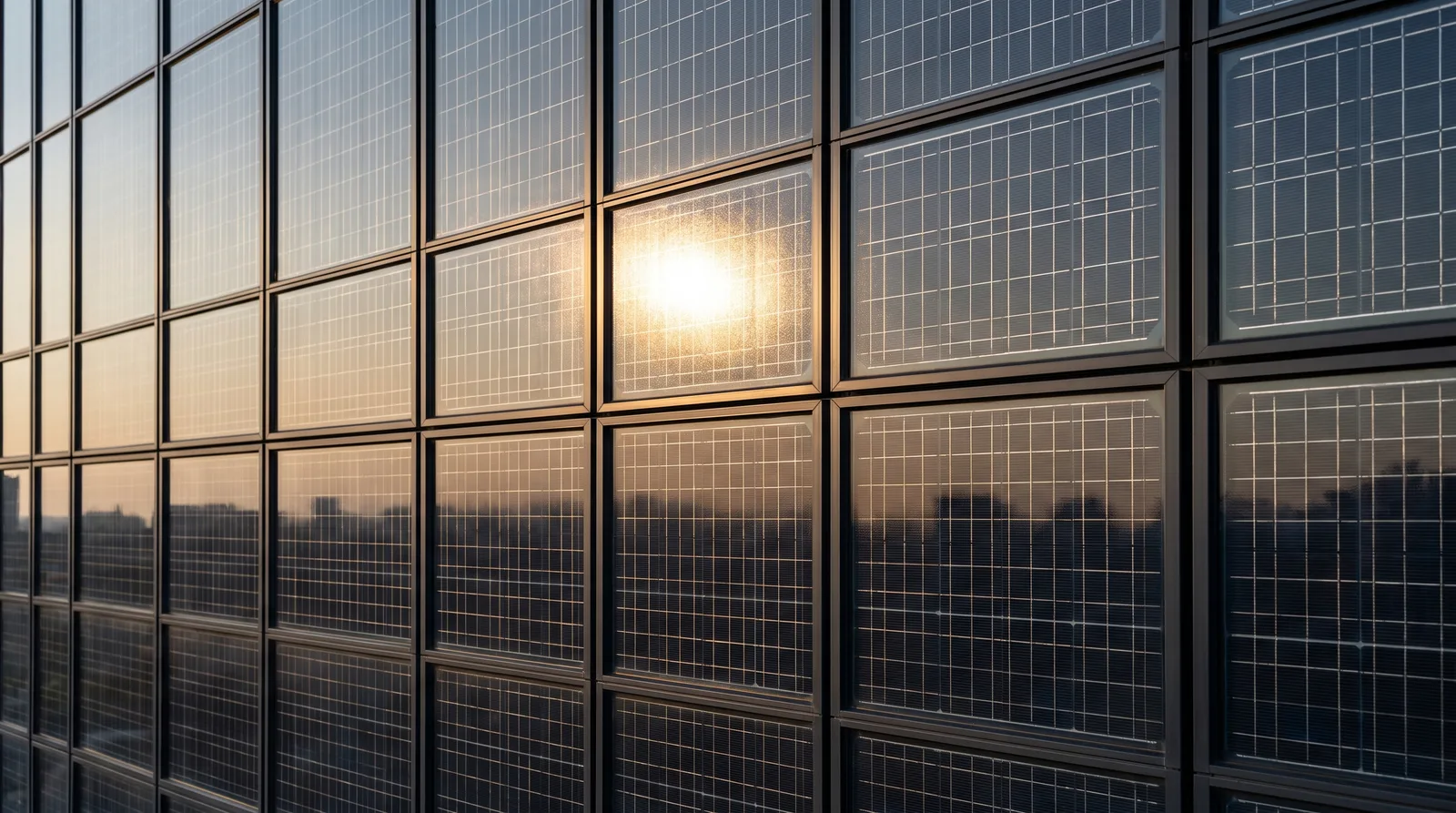
What separates BIPV from ordinary solar
Ordinary building solar (BAPV) mounts panels on a structure fixed to a finished building. With BIPV the module is the building material. It takes the place of the curtain wall glass, the façade panel, the shading louver, the roofing.
So the economics cannot be judged on module price alone. The cladding you were going to buy is no longer bought, which means the real added cost is the module price minus the price of the cladding it replaced. Add the generation revenue and the value of meeting the certification, and judge it on total cost.
There is real design freedom too. Products with adjustable color, pattern, and transparency mean the architecture does not have to be compromised to generate.
Why BIPV is worth assessing now
The Zero Energy Building (ZEB) certification requirement is already in force.
| Applies to | Requirement | In force |
|---|---|---|
| Public buildings, gross floor area 1,000 m² or more | ZEB grade 4 certification or higher, mandatory | In force since 2025-01-01 |
| Public buildings, gross floor area 500 m² or more | ZEB grade 5 certification, mandatory | In force since 2025-01-01 |
| Private buildings of 1,000 m² or more, and multi-unit housing of 30 units or more | Design standard equivalent to ZEB grade 5 | Applies from December 2025 |
| Next stage | Grade 3 level for public buildings; grade 5 level for private buildings of 500 m² or more | Scheduled for 2030 |
Swipe the table sideways to see the rest
As of 20 April 2026, 10,578 ZEB certifications had been issued in total, at an average energy independence rate of 44.53%.
The mandatory renewable energy installation ratio for public institutions is set at 36% for 2026 and 2027 and 40% for 2030, and BIPV carries a high correction factor, which helps in meeting it.
Where it can go
Curtain wall and glazing (glass to glass)
Cells set between two panes let daylight through while generating. Transmittance is tuned to the light level the interior needs.
Façade panel (glass to back-sheet)
Replaces opaque façade cladding. This is the highest-yielding application point.
Shading and louvers
Controls solar gain and generates at the same time. It cuts the cooling load on south-facing glazing.
Roof and canopy
The roofing itself is built from modules, or they are applied to a daylight canopy.
Integrated media façade
An exterior display combined with generation, used on landmark buildings.
Subsidies and product standards
BIPV is treated favorably in government deployment support programs. Under the 2026 Renewable Energy Deployment (Building Support) Program, the budget allocated to BIPV is KRW 7.378 billion. Support rates have run at around 50% for roof-mounted and 70% for wall-mounted work. A separate design grant has also been run, within 3% of total project cost and capped at KRW 25 million.
The product standard is KS C 8577 (performance evaluation requirements for building-integrated photovoltaic modules). A 2022 revision widened its scope to cover façades, louvers, blinds, and roof tiles.
Solar that uses existing structures such as buildings has carried a REC weighting of 1.5 (at 3,000 kW and below). The government and the agency state that after the shift to the contract market in 2027 this will be handled not as a weighting but as a preferential price set out in the tender notice.
Applications to the deployment program are normally taken once a year, and the 2026 round has already closed. If you are aiming at the next one, the preparation belongs in the design stage.
Sources: Ministry of Climate, Energy and Environment, 2026 Renewable Energy Deployment (Building Support) Program, Notice No. 2026-237 (2026-03-17) / KS C 8577 / National Assembly plenary passage (2026-08-20), as reported by Energy Daily, Newsis, and Korea Policy Briefing (2026-08-21)
What GRIDAEND does
BIPV is not something attached once the building is finished. The application points, the capacity, the design intent, and the budget only line up if the work starts early. So we join at the architectural design stage.
We calculate yield and economics for each application point, and put forward the combination that reaches the energy independence rate your target ZEB grade requires. Then we connect the manufacturers whose products match the specification and check eligibility for the deployment support program.
GRIDAEND works with specialist BIPV manufacturers and connects you to the product and the installation partner.