

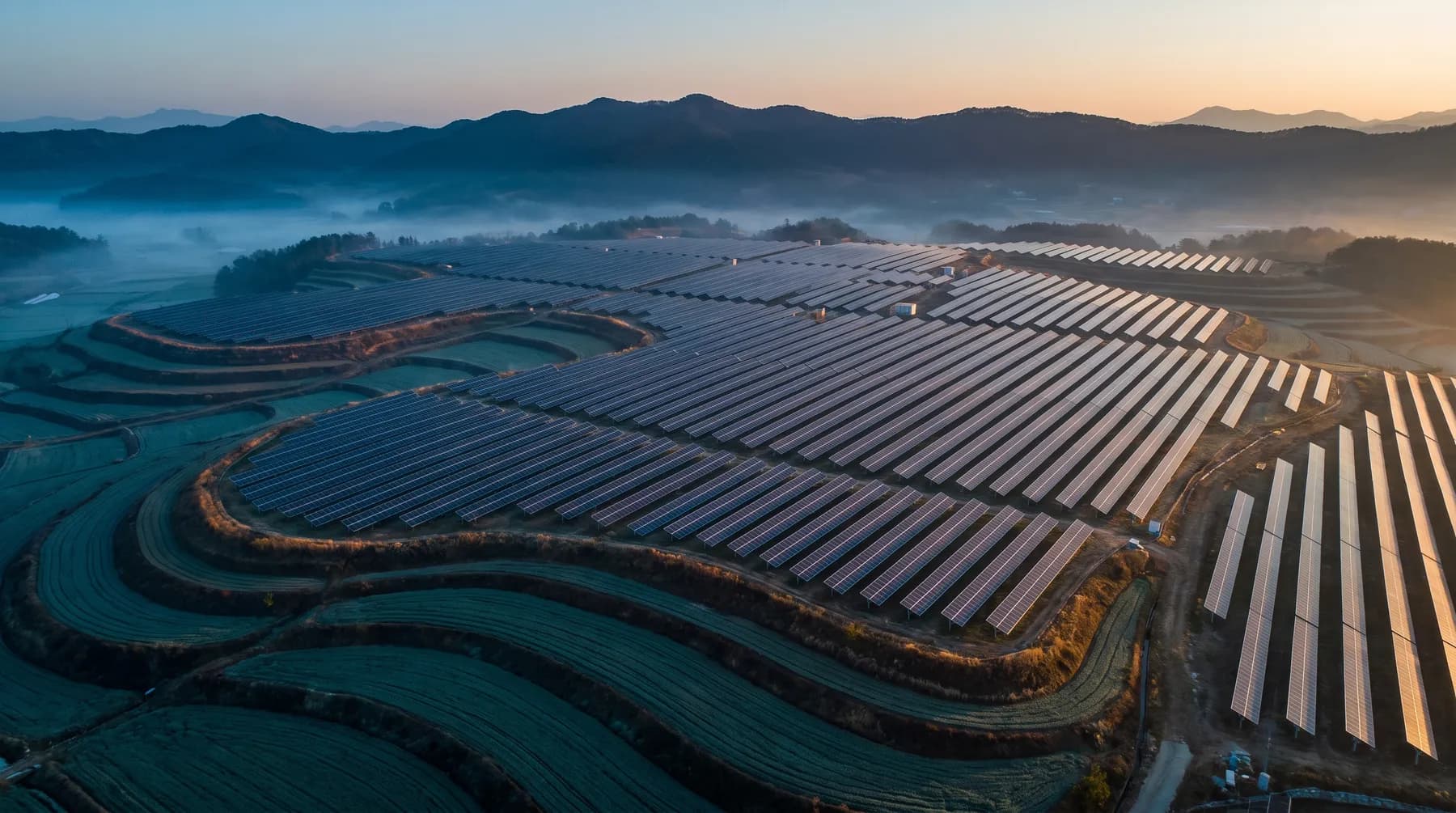
In September 2026, the setback rules change
The biggest obstacle to ground-mount solar has been the municipal setback ordinance — a different rule in every local government.
Two identical plots could be buildable in one city and not in the next.
The Act on the Promotion of Renewable Energy Development, Use and Deployment takes effect on 18 September 2026. It restricts setback rules as a matter of principle and standardizes the benchmark. Under the Enforcement Decree approved by the State Council on 11 August 2026, a solar setback may be set only within 200 m of an area of clustered housing (five or more dwellings). Community-participation, rooftop, and self-consumption installations are exempt from setbacks entirely.
Land written off because of a local ordinance is worth looking at again.
How the new rule applies in practice still depends on how far each local government has revised its own ordinance, so the standard in the jurisdiction has to be checked site by site.
Source: Enforcement Decree of the Act on the Promotion of Renewable Energy Development, Use and Deployment, approved by the State Council (2026-08-11); the Act takes effect 2026-09-18. Progress on revising local ordinances varies from one jurisdiction to the next.
Grid connection comes first
A plant with no route to send its power is a stopped project. As reported in July 2026, about 8.9 GW of renewable capacity sits in Korea's grid connection queue. In some regions a new connection is, in practice, hard to obtain.
Curtailment hits revenue directly. Nationwide curtailment came to 169,812 MWh across 2025. In 2026 the first half alone (January to June) reached 164,012 MWh, already close to the full prior year. It is concentrated in the Honam region.
In the initial feasibility assessment we check spare capacity at nearby substations and distribution lines together with the state of the queue, and tell you first whether this site can connect now.
Sources: Electric Times, 2026-07-10 (8.9 GW of renewable capacity in the grid connection queue) / Korea Power Exchange data submitted to the office of Assembly Member KIM Wi-sang, reported by Maeil Shinmun on 2026-08-04
A self-check for ground-mount sites
These items alone are enough for a first judgment. Leave blank anything you do not know.
Parcel number and area
The exact land parcel number (jibeon, the address) and roughly how large the plot is. A certified copy of the register or a land-use plan confirmation makes it more precise.
Land category and zoning
Whether the land is registered as field, paddy, orchard, forest, or miscellaneous land, and which land-use zoning designation applies — management area, agricultural and forestry area, and so on.
Distance to the nearest home
The distance to clustered housing is the basis on which the setback is judged.
Access road
Whether the plot fronts a road that construction vehicles can use, and whether it is landlocked.
Nearby poles and substations
A pole number or a substation close to the site speeds up the grid review considerably.
Slope and orientation
A gentle, roughly south-facing slope helps, but sloping ground can be corrected with the mounting structure.
Farmland and forest land bring a conversion procedure with them
Installing a plant on farmland requires farmland conversion permission or consultation; forest land requires forest land conversion permission. Whether it is possible at all, and what the levies come to, depends on the registered land category, the zoning designation, the gradient, and whether the land is designated for conservation.
If farming has to continue alongside generation, agrivoltaics is the route to look at.
It uses the land for a fixed term rather than converting it, so the approach is different.
Local acceptance is a real variable. A community-participation structure is exempt from setbacks, and there is now a legal basis for priority grid connection for public-interest community-participation projects of 1 MW or less.